In short
Cranial Facial Release (CFR) is a balloon-assisted cranial adjusting technique developed in the USA. It is rarely available in the UK. At SpineCentral in Hampton, London, we use a related but distinct method called ABC Endonasal Cranial Correction™ (ECC™), which works on the same nasal-cranial pathways but treats the skull as part of your whole-body structure rather than in isolation. If you have been searching for Cranial Facial Release in London, this article explains both approaches so you can make an informed choice.
If you suffer with persistent sinus congestion, facial pressure, headaches that build behind the eyes, jaw tension or breathing that never feels quite clear, you may have come across the term Cranial Facial Release, often shortened to CFR. It is one of the most searched cranial techniques in the world, and one of the least available in the UK.
This guide explains exactly what Cranial Facial Release is, where it comes from, what a treatment involves, and how it compares with the technique we use at SpineCentral: ABC Endonasal Cranial Correction™ (ECC™).
What is Cranial Facial Release (CFR)?

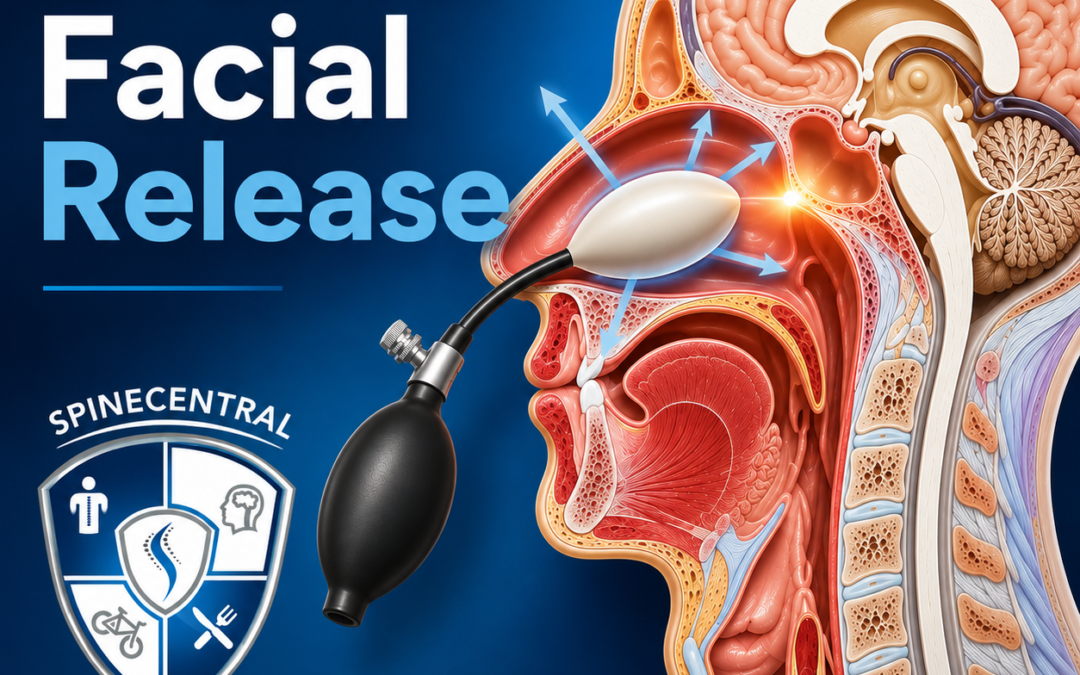
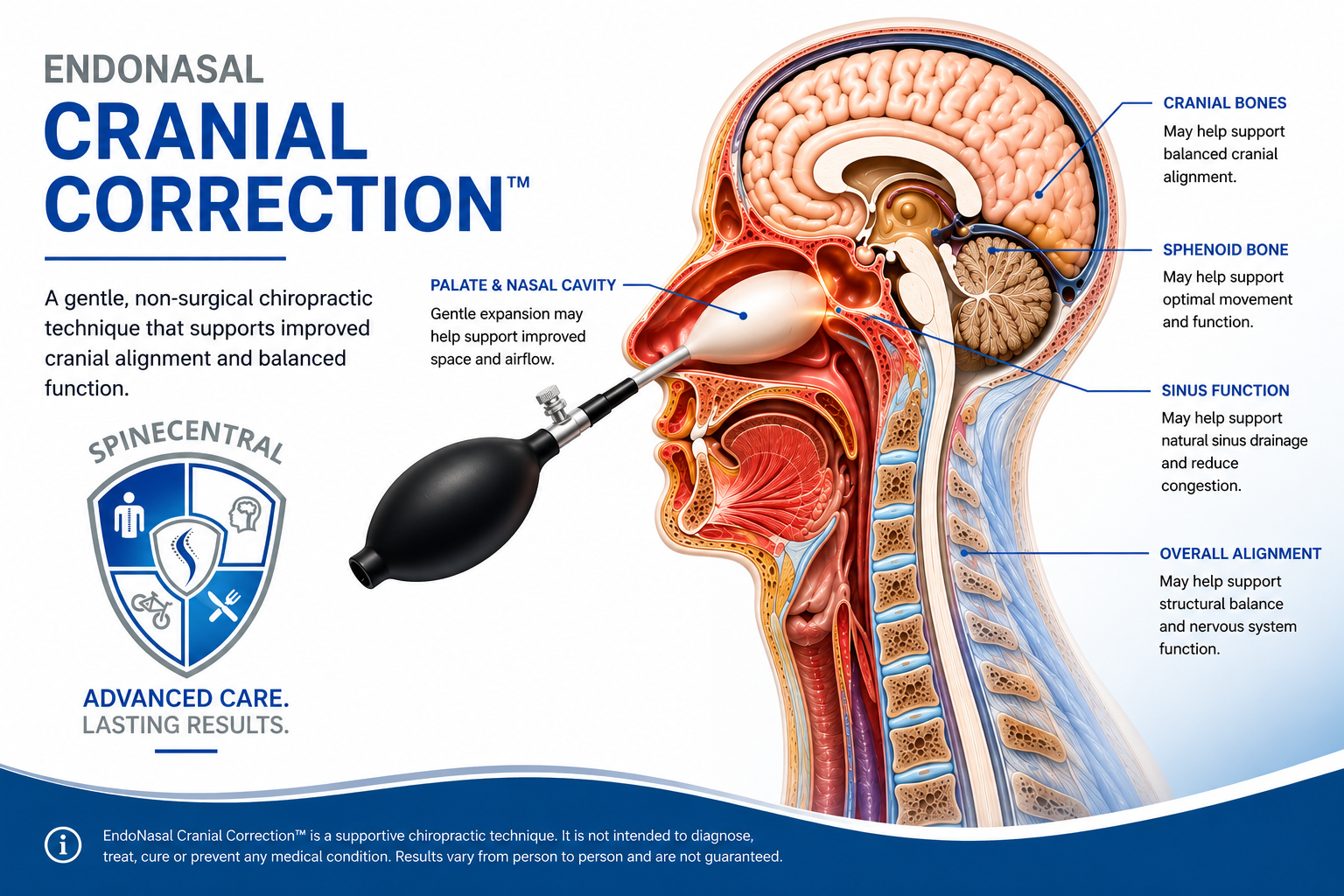
Cranial Facial Release is a balloon-assisted cranial adjusting technique. A small medical balloon is inserted into the nasal passages and briefly inflated for a fraction of a second. The inflation is designed to mobilise the bones of the skull and face, in particular the sphenoid bone at the centre of the cranium, with the aim of relieving tension in the cranial structure, opening the breathing passages and supporting normal fluid dynamics around the brain.
CFR was developed by American chiropractor Dr Adam Del Torto as a refinement of an older method called Bilateral Nasal Specific (BNS), created by chiropractor Richard Stober in the 1960s and 70s. The traditional CFR protocol is delivered as a series of visits, with specific inflation patterns administered on each day of the series.
You may also see the technique written as craniofacial release, cranio facial release or simply CFR. These all refer to the same balloon-assisted approach.
What do people use cranial techniques for?
People who seek out CFR and related endonasal cranial techniques typically do so for problems connected to the structure of the skull and face, including:
- Chronic sinus congestion and blocked nasal breathing
- Recurring headaches and migraines
- Facial pressure and tension around the eyes and cheekbones
- Jaw tension and TMJ discomfort
- Snoring and disturbed sleep linked to restricted nasal airflow
- A sense of head pressure following head knocks or concussion
An honest note before we go further. As with most manual cranial methods, there are currently no high-quality research trials proving the effectiveness of endonasal cranial techniques, including both CFR and ECC™. What we can share is the working theory behind the methods, our clinical experience, and what patients commonly report, so you can weigh it up for yourself.
Is Cranial Facial Release available in the UK?
CFR as a branded technique is taught primarily in the United States and very few UK practitioners offer it. In the UK, the more established route to endonasal cranial work is through Advanced BioStructural Correction™ (ABC™), whose cranial method is called Endonasal Cranial Correction™ (ECC™). SpineCentral in Hampton, London is a certified provider of ECC™, and our founder Richard Gliddon is President of ABC Europe, the body that trains practitioners in this method across Europe.
Cranial Facial Release vs Endonasal Cranial Correction: what is the difference?
Both techniques use a small balloon introduced through the nose to influence the alignment of the cranial bones. The difference is the framework around that procedure.
CFR is primarily a cranial technique. It focuses on the skull and face, delivered in an intensive series of visits.
ECC™ is part of a whole-body structural method. In the ABC™ model, the skull sits at the top of a body-wide compensation pattern. Misalignments in the cranial bones that the body cannot self-correct feed tension down through the spine, and spinal misalignments feed tension back up into the head. Correcting the cranium without addressing the spine, or the spine without the cranium, leaves half the pattern in place. At SpineCentral, ECC™ is therefore never a standalone treatment. It is applied within a full structural correction programme, only when your body’s own indicators show a cranial correction is what your structure needs next.
| Cranial Facial Release (CFR) | ABC ECC™ at SpineCentral | |
|---|---|---|
| Origin | Dr Adam Del Torto (USA), refined from Bilateral Nasal Specific | Advanced BioStructural Correction™, taught across Europe by ABC Europe |
| Scope | Cranium and face | Cranium corrected as part of whole-body structure, spine included |
| Typical delivery | Intensive series of visits with set inflation patterns | Applied within your structural care plan, only when your body indicates it is needed |
| UK availability | Very limited | Available at SpineCentral, Hampton, London |
| Procedure feel | Brief balloon inflation, seconds per pass | Brief balloon inflation, seconds per pass, with structural checks before and after |
What happens during an Endonasal Cranial Correction session?
- Assessment. We examine your full structure, spine and cranium, and test whether a cranial correction is what your body needs. If it is not indicated, we do not do it.
- The correction. A small, soft balloon is gently placed into one nasal passage and inflated for around a second, then removed. The sensation is unusual rather than painful. Most people describe momentary pressure followed by a noticeable sense of release.
- Re-check. We re-test your structure immediately, so you and we can both see and feel what changed.
- Integration. The cranial work is combined with ABC™ spinal correction so the whole compensation pattern unwinds together, not just one end of it.
Many patients notice a change in nasal airflow and head pressure straight away. Significant change in symptoms related to abnormal cranial mechanics is often seen within one to two sessions, though more may be required depending on your history.
Who is it for?
Endonasal cranial work may be worth exploring if you recognise yourself in any of these situations:
- You breathe better through one nostril than the other, and always have
- Your sinus issues return no matter how many sprays or rinses you try
- Your headaches sit behind the eyes or wrap around the temples
- You have never felt quite right since a head knock, fall or difficult birth
- You clench or grind, and your jaw clicks or aches
- You snore, wake unrefreshed, or feel your breathing is shallow at night
It is not suitable for everyone. Recent nasal surgery, certain medical conditions and some medications rule it out, which is exactly why every patient starts with a full structural examination rather than a standalone procedure.
Key takeaways
- Cranial Facial Release (CFR) is a balloon-assisted cranial technique from the USA with very limited UK availability.
- ABC Endonasal Cranial Correction™ (ECC™) uses a similar endonasal balloon procedure but corrects the cranium as part of your whole-body structure.
- Neither method has high-quality trial evidence yet. Our approach is to test, correct and re-test, so results are observable on your own body.
- SpineCentral in Hampton, London offers ECC™ within a complete structural correction programme, led by Richard Gliddon, President of ABC Europe.
Wondering whether your skull mechanics are part of your problem?
Book an initial assessment, £49. You get a full structural examination, your first treatment and a clear explanation of what we find, including whether Endonasal Cranial Correction is indicated for you.
Frequently asked questions
Do you offer Cranial Facial Release at SpineCentral?
We do not offer branded CFR. We offer ABC Endonasal Cranial Correction™, a related endonasal balloon technique delivered within a whole-body structural correction programme at our clinic in Hampton, London. If you were searching for Cranial Facial Release in London or the UK, ECC™ is the closest available method and, in our view, the more complete one.
What is the difference between Cranial Facial Release and Endonasal Cranial Correction?
Both use a small balloon inserted through the nose to mobilise the cranial bones. CFR focuses on the skull and face and is delivered as an intensive series. ECC™ treats the skull as one part of a body-wide structural pattern and is applied alongside ABC™ spinal correction, only when testing shows your body needs it.
Does the balloon treatment hurt?
The inflation lasts around a second. Most people describe it as a strange, intense pressure rather than pain, often followed by an immediate feeling of openness in the nose and lightness in the head. Eyes may water briefly. It is over very quickly.
How many sessions will I need?
It varies with your history. Change in symptoms related to abnormal cranial mechanics is often noticed within one to two sessions, though some people need more. Because we re-test your structure at every visit, you will always know whether further cranial work is indicated rather than being sold a fixed package.
Is Endonasal Cranial Correction safe?
The procedure is brief and non-surgical and is only performed after a full examination confirms it is appropriate for you. Certain conditions, recent nasal surgery and some medications mean we would not proceed. Honesty matters to us: there are currently no high-quality research trials proving the effectiveness of endonasal techniques, and we tell every patient that before they start.
Where can I get endonasal cranial treatment in London?
SpineCentral is at 29 Ashley Road, Hampton, London TW12 2JA, serving Hampton, Richmond, Kingston, Twickenham, Teddington and the wider SW London and Surrey area. Call 020 8941 4410 or book online.